What happens if you miss a credit card payment
· Updated
The due date has passed and the payment didn't go out, or it went out a day or two late. When the whole picture feels like a lot, it helps to take it one question at a time. This post covers whether it counts as late at all, and three things a missed payment can bring: a late fee, extra interest and a higher rate. It ends with what to do today. You're far from the only one who has been here, and the rules below give you more room than you might expect.
A few limits. This is about consumer credit cards in the US, and it leaves out charge cards. It doesn't cover credit scores. A late payment may be reported to the credit reporting companies, and section 6 links to the place to read more.
1. Check whether it's late at all
Start with "a day late", because some payments that feel late aren't.
- The cutoff is 5 p.m. Card issuers generally can't treat a payment as late if it's received by 5 p.m. on the due date, in the time zone stated on your billing statement. An issuer may set reasonable cutoff times for mail, online, phone and in-person payments. Each of them has to be 5 p.m. or later, except at a branch that closes earlier (below). (12 CFR 1026.10, CFPB)
- Received is the test. The payment has to be received by the due date. Mailing it on the due date is too late.
- The due date repeats. It falls on the same day of the month every billing cycle, and it's printed on each statement (12 CFR 1026.7).
- Weekends and holidays help mailed payments. If your issuer doesn't receive or accept mailed payments on the due date, a mailed payment received the next business day can't be treated as late. This rule covers mail. For online or phone payments, the next business day is up to the issuer.
- In person at a branch. If your issuer is a bank, savings association or credit union, a payment made at one of its branches counts as received that day, if you make it before the branch closes.
- A late statement. Issuers are required to have procedures that mail or deliver statements at least 21 days before the payment is due. If yours came late, contact the issuer (CFPB).
If the payment was received after the cutoff, read on.
2. The late fee
Your statement shows the late fee, and any higher rate (as an APR) that may apply after a late payment. It can show a range, or the highest one. That's the number for your card, so it's worth a look before anything else. How to read your credit card statement shows where that line sits.
Some limits sit on top of that number:
- A late fee can't be more than the minimum payment that was due. If your minimum was $15, for example, the fee can't be more than $15 (12 CFR 1026.52).
- One late payment gets one late fee. An issuer can't charge more than one penalty fee for the same event.
- A second late payment within the next six billing cycles can carry a higher fee than the first.
You can also ask. If the payment arrived late, you can contact the card company and ask whether it would consider waiving the late fee. They may say no, and asking costs a phone call (CFPB).
3. Interest and the grace period
Card companies can choose whether to give a grace period. If your card has one, you usually avoid interest on purchases by paying the balance in full by the due date. Miss that, and you're charged interest on the unpaid part and on new purchases from the day each is made. Paying in full some months and not others can lose the grace period for the month you don't pay in full and the month after (CFPB).
If you normally pay in full, a missed payment can mean interest where there wasn't any before. If you carry a balance from month to month, interest keeps running as usual.
4. A higher rate (penalty APR)
This is the one the statement line from section 2 is about. An issuer can raise your rate after a late payment, on conditions:
- On new purchases: the issuer has to send written notice at least 45 days before the higher rate starts. The notice has to say which balances it applies to and why. The higher rate can't apply to purchases made before, or within 14 days after, the notice. An issuer can't use this route in the first year of the account (12 CFR 1026.9, 12 CFR 1026.55).
- On the balance you already have: the issuer can raise the rate only when it hasn't received your minimum payment within 60 days after the due date.
If that second case happens, the notice has to say when the higher rate stops: once you make six minimum payments in a row on time, starting with the first one due after the increase. After six, the issuer is required to bring the rate on those balances back down. That applies to purchases made before, or within 14 days after, the notice.
After raising a rate, an issuer also has to review the account at least every six months and lower the rate if the review calls for it (12 CFR 1026.59).
5. What to do today
- Pay at least the minimum as soon as you can. The 60-day mark above is about the minimum payment. Once it's paid, nice work.
- Ask about the fee. One phone call, and the answer might be yes.
- If you can't pay, call the card company right away. The CFPB says many card companies are willing to work with you to change your payment in a financial emergency. Tell them why you can't pay the minimum, how much you can afford, when you could restart normal payments, and what payment you're asking for and for how long (CFPB).
You don't need to be behind on payments to ask for help. Not responding can lead to higher interest rates, higher minimum payments, late fees and losing the ability to use the card (CFPB).
6. What this post leaves out
Credit scores. A late payment may be reported to the credit reporting companies. For how that works, the CFPB's credit reports and scores page is the place to read more.
Where Unspending Spree fits
Every card and loan's due date in one place, and on your Google Calendar if you connect it. That's what See What's Due does in Unspending Spree, with due date tracking, Google Calendar sync and a calendar file export.
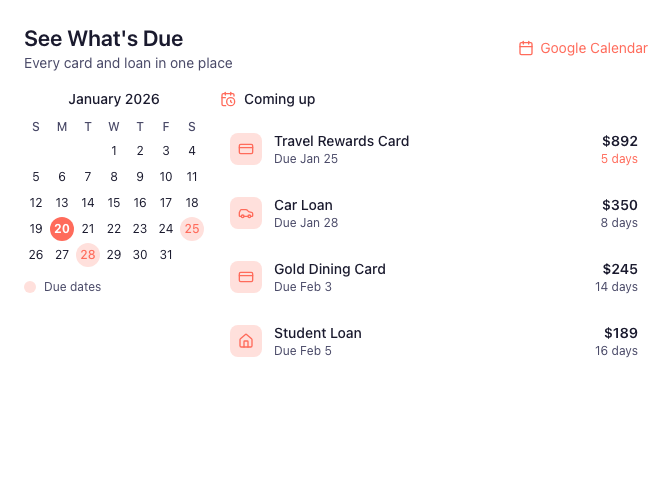
Unspending Spree also keeps credit cards, loans and balances in one place. Track interest rates, minimum payments and estimated payoff dates without logging into multiple sites. AI reads PDFs and photos: account details, transactions, APR and due dates. Link your bank through Plaid with read-only access.
Calculations are estimates based on your data and current rates. Not financial advice.