Debt snowball vs. debt avalanche: which is better for you?
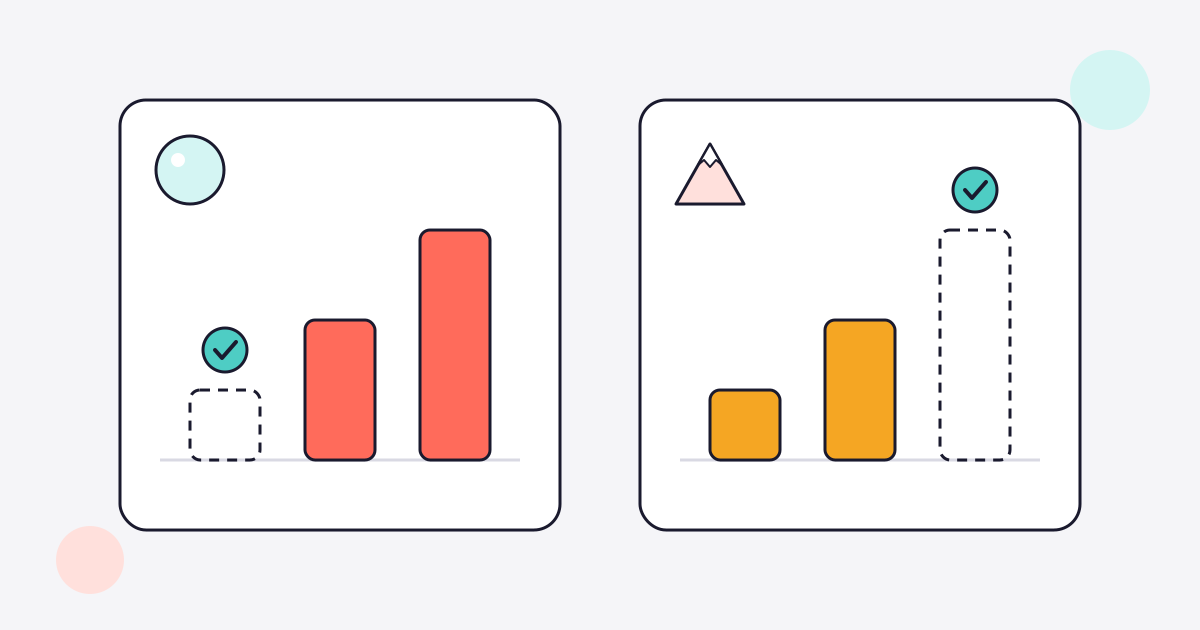
Debt snowball and debt avalanche are two answers to the same question: which debt gets your extra payment first. Both methods pay every minimum every month. Then whatever's left goes to one debt at a time. The debt avalanche method sends that extra payment to the balance with the highest interest rate. The debt snowball method sends it to the smallest balance instead. The avalanche usually costs less interest over time. The snowball usually closes an account sooner. Research suggests that early win can matter to how well some people stick with the plan. Which is better for you depends on your own rates, balances, and how you tend to stay motivated.
1. What both methods share
Start by listing every debt: balance, APR, and minimum payment. Pay every minimum, every month, on every debt, no exceptions. Whatever's left of your monthly amount toward debt goes to one debt, on top of its minimum. When that debt hits zero, its payment rolls onto the next debt in line. The payment carries over both the old minimum and the extra you'd been sending it. Your total monthly amount toward debt stays the same the whole time.
The only difference between the two methods is which debt goes first.
2. The debt snowball method: smallest balance first
The debt snowball method sends your extra payment to whichever debt has the smallest balance, no matter its interest rate. Once that balance is paid off, its payment rolls onto the next-smallest balance. Each payoff frees up a bigger payment for the next debt, so the payments toward what's left keep growing.
3. The debt avalanche method: highest interest rate first
The debt avalanche method sends your extra payment to whichever debt carries the highest interest rate, no matter its balance. Once that debt is paid off, its payment rolls onto the debt with the next-highest rate. The Consumer Financial Protection Bureau describes this as the highest interest rate method in its debt-reduction worksheet, alongside the snowball method, and lists a trade for each.
4. Snowball vs. avalanche on the same debts
Say you owe on a store card and two other cards, and you can put $450 a month total toward all three. To keep the arithmetic simple, each minimum payment holds steady for the life of the example.
| Debt | Balance | APR | Minimum |
|---|---|---|---|
| Store card | $1,200 | 21% | $40 |
| Card B | $3,000 | 24% | $90 |
| Card A | $6,000 | 29% | $180 |
Those rates sit around and above the average rate on credit card accounts assessed interest, 22.15 percent in the second quarter of 2026 (Federal Reserve G.19).
The avalanche sends its extra payment to Card A first, since it carries the highest rate. The snowball sends its extra payment to the store card first, since it's the smallest balance.
| Avalanche (Card A first) | Snowball (store card first) | |
|---|---|---|
| First debt paid off | month 26 | month 8 |
| All paid off | 32 months | 33 months |
| Total interest | about $3,990 | about $4,390 |
The avalanche closes Card A in month 26, Card B in month 31, and the store card in month 32. The snowball closes the store card in month 8, Card B in month 19, and Card A in month 33. About $400 in interest and one month separate the two paths, and the snowball's first payoff lands 18 months sooner.
5. What research says about the quick win
Why would anyone pick the method that costs more? In lab experiments using a debt-repayment game, people tended to pay off small debts first even when larger debts carried higher rates. The researchers call this pattern debt account aversion (Amar, Ariely, Ayal, Cryder and Rick, 2011).
In a large set of real debt records, people who had closed a bigger share of their accounts were more likely to get out of debt altogether. This held regardless of the dollar size of those closed accounts. The authors suggest that finishing smaller pieces may help some people keep going. They also note that when rates and balances differ enough, the cheaper strategy's savings outweigh whatever motivation a small win provides, and that the reverse may often hold too (Gal and McShane, 2012).
One study found that concentrating payments on one account at a time, rather than spreading them across several, tended to boost people's motivation to become debt free. The effect was strongest when that one account was the smallest (Kettle, Trudel, Blanchard and Häubl, 2016). Both the snowball and the avalanche concentrate payments this way. Only the snowball also happens to pick the smallest account first.
None of this shows that the snowball costs less. One estimate puts its extra cost at roughly 1.8 to 4.3 percent more in interest for the average household that follows it (Hamilton, 2023). The avalanche is usually the cheaper path. The open question is whether a given person's early win is worth what it costs them.
6. How to choose
There's no single right answer, but a few honest questions can point you toward one:
- How far apart are your rates? The wider the gap between your highest and lowest rate, the more the avalanche tends to save.
- How long until the avalanche's first payoff? If your highest-rate debt is also your largest, that first win might be a long way off.
- Would an early win help you keep going? Some people stick with a plan better once the first debt is gone.
You don't have to pick one method exactly as written, either. You could clear one small balance first for the early win, then switch to highest rate for the rest, or set your own order some other way. The method you actually keep up beats the one you abandon at month four, whichever one that turns out to be.
A bigger monthly amount gets either method there faster. How to find hidden subscriptions is one way to find room for that.
7. Track it month by month
Whichever order you pick, a simple spreadsheet can track it. One row per month, one column per debt, holding the balance, the interest added, and the payment made, until every balance hits zero. That's what a debt snowball tracker really is, whether you're running the snowball, the avalanche, or an order you set yourself.
The interest and payoff month in each row come from the same arithmetic as any credit card payoff. How long will it take to pay off your credit card? walks through that arithmetic for one card; the same math repeats across every row here.
Where Unspending Spree fits
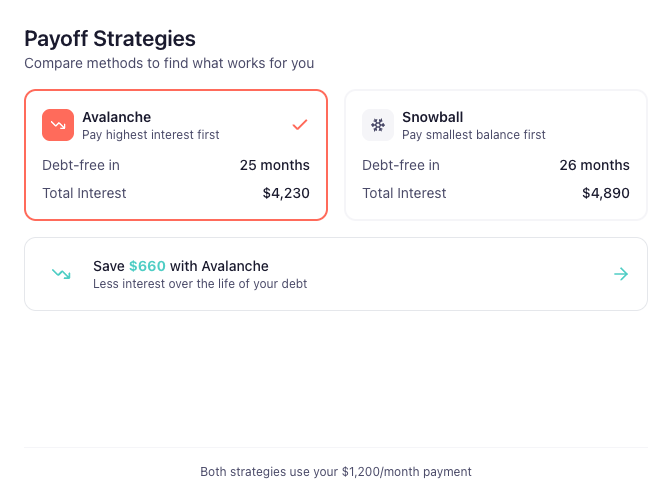
Unspending Spree connects to your bank through Plaid with read-only access. It compares the avalanche (highest interest rate first) and snowball (smallest balance first) methods on your debts. It shows how each affects your timeline and total interest paid. You can set your own payoff order too, if neither method fits exactly. It estimates when you could be debt-free from the plan you set, and shows how a bigger payment moves that date.
Calculations are estimates based on your data and current rates. Not financial advice.